

The screwworms are here, as we predicted they would be. More than half a century after the parasitic pest was declared eradicated, the insects have escaped containment in South America and made it all the way to Texas, where they have not been seen since 1966. There are now five cases of the flesh-eating parasite in the United States, all confirmed in under a week. The first two were in calves in Zavala County, followed soon after by a calf in La Salle County; a goat in Gillespie County; and a dog that lives in Lea County, N.M., but recently traveled through Texas. These five cases are alarming but expected, as Secretary of Agriculture Brooke Rollins tweeted. On this fact, Rollins is correct.
But expected is different from inevitable. The screwworm's arrival was expected because over the past few years the insects have been wriggling toward our border with Mexico, somehow surging past the boundary of Panama's Darién Gap. This boundary was enforced by the Sterile Insect Technique, in which hordes of engineered and irradiated sterile males kept the flies at bay. Rollins blamed the screwworm's reappearance on "the open-border policies of the last administration," which is incorrect and obviously racist. There is no evidence that human migration has helped the screwworm's sprawl. If there is blame to assign, it should be directed at the Trump administration, which helped pave the screwworm's path up north. The DOGE cuts in the spring of 2025 terminated USAID funding for a program that monitored and contained the screwworm in Central America and USDA funding that supported screwworm outbreak investigations and responses in 22 countries. After Joe Biden closed southern ports of entry to live cattle from Mexico to box out the screwworm in 2024, Donald Trump reopened those ports in February 2025. (The ports were closed again later that May.)
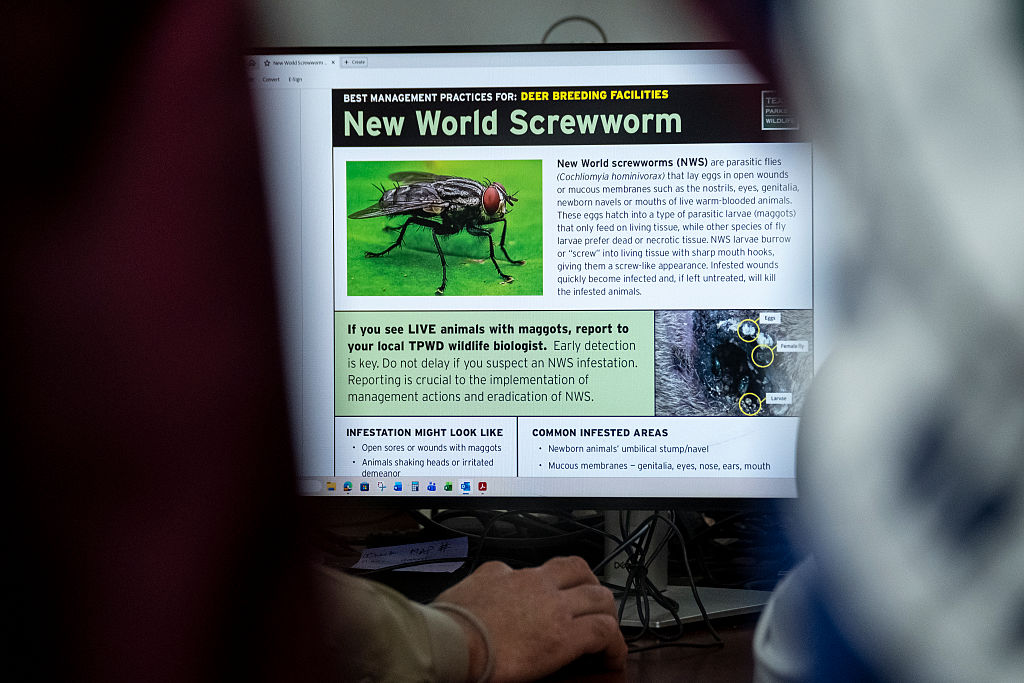
The New World screwworm is a maggot, specifically the larvae of a parasitic blowfly that feeds on warm-blooded animals. But while most maggots feed on dead flesh, the screwworm only feeds on fresh wounds. So while other flies are content with carcasses, dung, and things of that nature, screwworms often seek out broken skin on living animals. But they'll also, horribly, lay their eggs on mucous membranes, including eyes, lips, or even an anus or vagina. Females lay their eggs inside the open flesh, eggs that hatch into larvae that gnaw and burrow into their host's skin.
Screwworms will happily feed on any warm-blooded host: cow, cat, crypto entrepreneur, etc. They can dig through skin, muscle, and even into a human skull. But the threat screwworms pose to people is low and treatable if caught early. The people most at risk are those working in agriculture in the South, especially those whose jobs can cause open wounds. (If you'd like to know more about what a screwworm infestation looks like on a person, I recommend this thoroughly disgusting story by Beth Mole at Ars Technica with some of the most horrible hyperlinks I've ever seen but refused to click.)
The real risk is to cattle and other livestock. Practices like shearing and dehorning can and do break bovine skin. Giving birth makes a mother and her calf vulnerable, and the flies appear particularly drawn to laying eggs around the umbilical cord. (This is where the larvae cut their teeth on that first Texan calf.) Even a tick bite can serve as an open invitation for a screwworm. Once a screwworm gets into a cow, the animal is doomed to die without treatment. An undetected infestation can kill a cow within a week, as Emily Anthes reported for The New York Times.
So what does all of this mean? The beef you eat, if you eat beef, remains safe and worm-free. And it remains expensive. Things are bleak for the $100 billion U.S. beef industry, with the nation's cattle herd at its smallest since 1951, per Reuters. Now that Mexico can no longer send live cattle across the border, the country is exporting more and more prepared beef to the U.S and seeing more and more profit. If the screwworm cases rise to the point of an outbreak, losses could exceed $3 billion in the Southwest.
There are measures in place to prevent the screwworm's spread, but they're a long ways away. A $750 million sterile fly production facility is in the works in Edinburg, Texas, but won't open until the fall of 2027. The USDA established a 20-kilometer "infestation area" around the spots where the fly was detected. And veterinarians are on high alert for signs of the worm. Otherwise, the onus remains on ranchers to check their cattle, and themselves, for signs of the odious maggots. The USDA has recommended daily inspections and preventative treatments for the livestock, per Reuters. This is a tall and probably impractical order. The cattle are so big and numerous, and the flies are so small. The ranches are understaffed, facing severe labor shortages. Screwworms are easier to spot once an infestation has set in, a point at which it may already be too late for the infected.
The screwworms feel like a fitting plague for these nightmarish times, like if the locusts came, except instead of eating all our crops they laid eggs inside the scratches on our heads so that their babies might wriggle adorably into our craniums. Their range has been expanded by climate change, meaning future New World screwworms are poised to go where no New World screwworm has gone before. Perhaps another, more capable administration might be able to stop or slow the screwworms. But it will not be this one.
Despite what the Trump administration might want to believe, the New World screwworm is not a migrant to the U.S. The insect, as its name suggests, is native to the Americas. It was always around, heinously squirming on the eyeballs of any warm-blooded creature unlucky enough to make its acquaintance. And its threat increased significantly after the spread of animal agriculture created bountiful buffets on which the worms might feast. We have only been rid of the dreadful parasite for so many years because of Edward F. Knipling and Raymond C. Bushland, the two USDA scientists who developed the Sterile Insect Technique and created a blueprint for the screwworm's containment. This technique has also been used to control other deadly insects, such as the Aedes aegypti mosquito. As government scientists, Knipling and Bushland's research was federally funded. (They two first became friends while watching mating screwworm flies go at it in their breeding cages.)
This research on the sexual behavior of the screwworm has historically been targeted by politicians seeking to spotlight wasteful federal spending. They could not have been more wrong; Knipling and Bushland's technique has saved the U.S. more than $1.8 billion each year. The scientists were posthumously awarded a "Golden Goose Award," which honors federally funded work that might have been dismissed as silly or inane but resulted in significant benefit to society.
It's unclear if, or hopefully, when, the U.S. will be able to beat back the screwworm once more. One rancher told Reuters that his hopeful timeline was that the fly would be controlled in two years and eradicated in five. This would totally be possible if we had a robust, federally funded program dedicated to monitoring and containing the screwworm and a government committed to working collaboratively with Mexico and countries in Central and South America. Oh well! In the meantime, if the worms make their way to Washington, I hear there's a particularly tasty, wounded hand just begging for some larvae.
Correction (2:45 p.m. ET): An earlier version of this story incorrectly claimed screwworm research had been awarded the Golden Fleece Award. While a common target for those attacking "wasteful" government spending, the screwworm study predated the existence of that award.